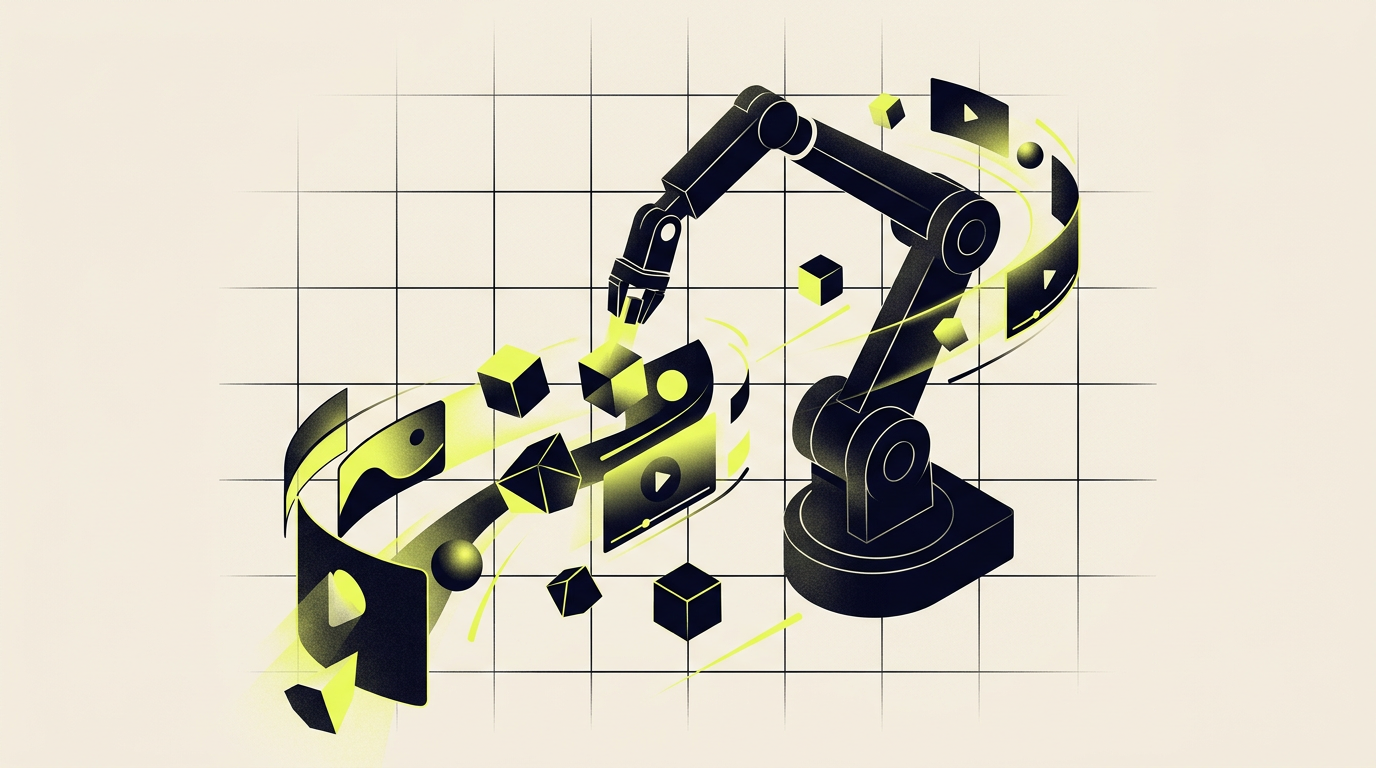
To successfully create social media content with AI in 2026, brands must move beyond isolated prompt-to-image workflows and deploy governed AI pipelines that automate motion graphics, adapt branded templates, and orchestrate distribution. Rather than relying on a single AI content generator for static imagery, modern teams use API-driven workflows to turn core messaging into platform-specific video assets. This approach bypasses the algorithmic penalties applied to low-effort AI content and maintains strict brand identity at scale.
Over the past two years, the landscape of social media marketing has fundamentally fractured. On one side are businesses mass-producing generic content that social algorithms now actively suppress. On the other side are teams leveraging custom AI architectures to produce high-fidelity, motion-rich campaigns that capture actual market share.
Here is exactly how technical marketers and creative teams are architecting their workflows to win in 2026.
The 2026 Reality: How Much Social Media Content is AI Generated?
A common question we hear from founders looking to modernize their marketing is: how much social media content is AI generated today?
While exact percentages fluctuate by platform, industry consensus in 2026 indicates that a vast majority of B2B and DTC static social posts contain at least some AI-generated elements—whether that is copy drafted by an LLM, backgrounds expanded via generative fill, or entirely synthetic product photography.
Because of this saturation, major platforms like LinkedIn, Instagram, and TikTok have deployed sophisticated "slop filters." These algorithms de-prioritize recognizable, low-effort AI outputs. If your strategy relies on pasting text into a basic AI content generator and posting the immediate result, your reach will be severely throttled. The new algorithmic baseline requires dynamic, highly branded, and motion-heavy content.
Evaluating the Modern AI Powered Content Creation Platform
To compete, businesses need to upgrade their tool stack. You generally have two paths: adopting an all-in-one SaaS platform or building a custom AI pipeline connected to headless creative APIs.
All-in-One SaaS (The Out-of-the-Box Approach)
Platforms like Blaze AI and SocialBee have evolved significantly. They are no longer just scheduling tools; they position themselves as comprehensive AI powered content creation platforms.
- Blaze AI: Specializes in brand voice matching and multi-channel campaign generation. It is highly effective for teams that need to turn a single blog post into a week's worth of LinkedIn posts, Twitter threads, and basic graphic layouts.
- SocialBee: Combines robust social media management tools with integrated AI copilots. It excels at categorized evergreen posting and automated hashtag/copy generation.
The limitation: While excellent for copy and static asset management, these platforms often struggle to generate custom, brand-specific motion graphics or complex video editing at scale.
Custom Composable Pipelines (The Motion-First Approach)
For brands where visual identity and video are paramount, an out-of-the-box solution is rarely enough. At PixelorCode, we help clients build composable architectures. This involves linking specialized AI models through workflow orchestrators (like n8n) to automatically generate motion content.
| Feature Requirement | All-in-One Platforms (Blaze AI, SocialBee) | Custom AI Pipeline |
|---|---|---|
| Setup Time | Fast (Days) | Moderate (Weeks) |
| Brand Voice Governance | Good (Custom Instructions) | Excellent (RAG & Fine-tuned models) |
| Motion/Video Generation | Limited / Templated | Advanced (via Runway Gen-3 / Luma APIs) |
| Workflow Flexibility | Restricted to platform UX | Infinite (Node-based logic) |
| Pricing Model | Predictable monthly SaaS subscription | Variable (Based on API usage and compute) |
How to Use AI to Create Content for Social Media (That Actually Converts)
If you want to know how to create social media content with AI that avoids the slop filter, you need a workflow that prioritizes brand governance and motion. Here is a blueprint for a modern 2026 pipeline.
Step 1: Ingesting Core Data and Trends
High-performing social content isn't created in a vacuum. A modern workflow begins by feeding an LLM your proprietary data. Instead of asking AI to "write a post about web development," you use an automated webhook to feed the AI your latest internal project case study, combined with real-time trending topics scraped from your industry.
Step 2: Orchestrating the Brand-Governed Asset Generation
Once the core narrative is established, the pipeline splits the task:
- Copywriting: A custom LLM (equipped with Retrieval-Augmented Generation to ensure it strictly follows your brand voice guidelines) drafts the platform-specific copy.
- Visual Prompting: A secondary agent translates the copy into highly specific visual prompts.
- Asset Creation: These prompts are sent to specialized generative APIs to create base layers (e.g., product images in specific environments).
Step 3: Pushing to Motion and Video Versioning
Static images no longer cut it. The base assets are passed through a motion API (like Runway Gen-3 Alpha or custom ComfyUI workflows) to add cinematic movement, typography animations, and dynamic transitions. Finally, an automated rendering script reformats the video into 9:16 (for Reels/TikTok) and 1:1 or 4:5 (for LinkedIn/Instagram feeds) before pushing the final assets to your preferred social media management tools for approval.
Integrating Social Media AI Chatbots
Creating the content is only half the battle; engagement dictates reach. Once motion content is live, modern brands deploy social media AI chatbots linked to the exact campaign context.
If your AI-generated motion graphic promotes a new B2B software feature, the chatbot monitoring the comment section is pre-loaded with the technical documentation for that specific feature. When a prospect comments on the video asking a technical question, the chatbot can reply instantly and accurately in the brand's tone, driving the user from a social platform directly into a sales funnel.
Frequently Asked Questions
How to use AI for social media content without sounding generic? The key is avoiding zero-shot prompting. Never ask an AI to generate content from scratch. Always ground the AI using Retrieval-Augmented Generation (RAG) linked to your internal knowledge base, style guides, and past top-performing posts.
What is the best AI content generator for video? In 2026, there is no single "best" generator; it depends on the usecase. Runway and Luma dominate cinematic B-roll and atmospheric motion, while tools like HeyGen are utilized for talking-head localized content. The strongest strategies use API orchestrators to route tasks to the specific model best suited for the job.
How much of social media content is AI generated by competitors? While exact metrics are proprietary to platforms, marketing analysts estimate that over 60% of brand-published static assets involve AI workflows. However, fewer than 10% of brands have successfully automated high-fidelity motion content, representing a massive competitive gap you can exploit.
Can I use AI to automate my entire social media presence? You can automate the production and distribution, but human oversight remains critical for strategic direction and quality assurance. "Set and forget" pipelines inevitably drift off-brand. AI should be treated as a high-speed production studio, not a substitute for a Creative Director.
Building Your 2026 Content Architecture
Figuring out how to use AI to generate social media content is no longer about finding the right prompt; it is about building the right infrastructure. By shifting away from basic AI content generators and investing in integrated, motion-first platforms, brands can bypass algorithmic penalties and scale their creative output without sacrificing quality.
Whether you are evaluating SaaS tools like Blaze AI or looking to build a fully bespoke video generation pipeline, the technology is only as good as the strategy governing it. Pricing and implementation timelines vary wildly depending on API usage, custom model requirements, and existing infrastructure.
At PixelorCode, we specialize in helping creative and tech brands design, build, and deploy these advanced AI workflows. If you are ready to move beyond static AI slop and build a content engine that actually compounds, contact our team today to discuss your architecture.